
Olive Oil Extraction Processes
The most important difference in olive oil extraction is that it can be done mechanically, without using chemicals as with most seed oils.
Traditional Olive Press
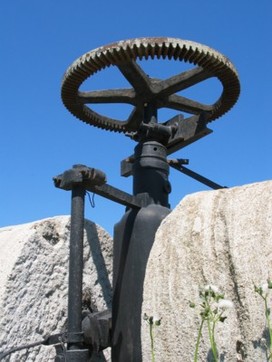
Pressing is the oldest method of the olive oil extraction processes. The method involves applying pressure to stacked filter mats, smeared with paste, that alternate with metal disks; a central spike allows the expressed oil and water (olive juice) to exit. The machinery, however, is cumbersome, the process requires more labor than other extraction methods, the cycle is not continuous, and the filter mats can easily become contaminated.
Cleanliness of the mats is extremely important. Each time the mats are used small particles of paste plug the filtration channels and can cause a loss of oil. The number one problem with traditional presses is the transfer of fermentation defects from the mats into the oil. Mats can start to ferment if not used continuously or if not cleaned regularly. The solution is to wash the mats every day, or to use the presses continuously until harvest is finished. Oil from presses falls into both extremes; producing the best oils when properly operated because they tend to have greater flavor and higher polyphenol content. Many defects, such as fermentation of mats are higher in press systems compared to continuous flow olive oil extraction processes. Studies vary in their conclusions for ratings of oils from presses in sensory analysis: some rate them higher, others lower. Management of the system seems to be the most important variable. This is really dry reading and probably much more than you want to know, but if you're interested...read on :)
Selective Filtration -Sinolea ProcessThis process is the opposite of the press system since no pressure is applied to the paste. It operates on the principle that in a paste containing solid particles, water, and oil, the oil alone will adhere to metal. The machine has stainless steel blades that dip into the paste, the adhering oil then drips off the blades into a separate container while the solids and water are left behind. The lack of pressure these olive oil extraction processes produces light oil with unique quality and value.
The equipment is complicated and requires frequent cleaning, maintenance of the stainless steel blade mechanisms, and a constant heat source to keep the paste at an even temperature. Extraction is stopped when vegetable water begins to appear in the oil. Decanters 2-phase or 3-phaseHistorically, olive paste, or olive juice containing both water and oil was allowed to sit in containers until the oil, with a lower specific gravity, rose to the top naturally. The oil was then decanted away from the remaining water and solid material. This natural separation takes considerable time and the contact of oil with enzymes, breakdown products and fermenting fruit water produced defective oils. Modern decanters are large horizontal centrifuges that separate the oil from the solids and water in the same process as in a decantation tank, just faster. The savings in time increases the efficiency of the system, but also decreases the time the oil is in contact with the fermenting fruit water.
The decanters spin at approximately 3,000 rpm. Centrifugal force moves the heavier solid materials to the outside; a lighter water layer is formed in the middle with the lightest oil layer on the inside. There is no exact line of separation between the three phases of solid, water, and oil so the solid phase usually has some water in it, the water has some oil in it and the oil contains some water. In the latter case, which extracts the maximum quantity of oil, an additional vertical centrifugation is used to remove more of the vegetation water from the oil. 3-Phase System Decanters3-Phase system Decanters separate the paste into a relatively dry solid, fruit-water, and oil. Water is added to this system to get it to flow through the decanter. A minimum quantity of water is added to separate the solid material better and to retain water-soluble polyphenols as much as possible.
The system should be run at approximately 65 to 70% of maximum capacity to get good separation of phases. Samples should be taken every hour and analyzed daily to determine the status of the separation. Preferably, the solid should have an oil content of no more than 6-7% and 50% moisture while the vegetation water should not contain over 0.3% oil and-8% solids. |
|
2-Phase System Decanters
|
2-Phase system decanters were introduced in the early 1990's. They function under the same principle as 3-Phase decanters except that the solid and fruit-water exit together. No water needs to be added to the 2-Phase system.
Experience with the two olive oil extraction processes shows that the 2-Phase system has some advantages, i.e., better retention of polyphenols because no water is added and less loss of oil if the system is operated properly. One problem with the 2-Phase system is a greater potential to lose oil when the olives are low in moisture because there is a thinner interface between the two phases during centrifugation. Another difficulty is less visualevidence of what is happening with waste characteristics because the solid and vegetation water phases are mixed. Water can be added to the paste just prior to entering the 2-Phase decanter if the moisture content of the olives falls below 42%. Talc (a water absorbing neutral compound) can beadded to the paste early in the season, if the olives have an excessive moisture content, to help extract a greater quantity of oil with no negative effect on quality. The 2-phase system produces the greatest weight of solid waste because it has the highest moisture content. It also produces the least amount of wastewater with the lowest Biological Oxygen Demand (BOD). The polyphenol content of the oil is lowest in the 3-phase system because of the addition of water. When very clean oil (containing no water) is obtained from a 2-Phase system, it means that there is a loss of oil to the waste solids because of the limited separation area within the decanter. The solution is to extract oil with some water in it and immediately run it through a vertical centrifuge to clean the oil further. Vertical Centrifuge Vertical centrifuges spin at two times the velocity of a decanter and provides four times the separation force for the solid, water, and oil phases. They provide an additional separation of the three phases to further remove solid particles and water from the oil. Fresh warm water is added to "clean" the oil, creating a greater interface area between the phases. Many processors use two centrifuges, one for the "wet" oil from the decanter and a second one to separate the oil from the wastewater of the first centrifuge. Added water is only 2-4°F warmer than the water/oil mixture to be separated. Reprinted with permission from and written by Paul Vossen, Fruit, Vegetable & Marketing Advisor, Sonoma County University of California Cooperative Extension. |